Every conversation I have about land in America eventually runs into the same set of numbers. They’re not complicated, but together they describe one of the largest and least-discussed transfers of wealth in American history — a handoff of farmland that is happening right now, mostly out of public view. Here’s the picture, in four charts.
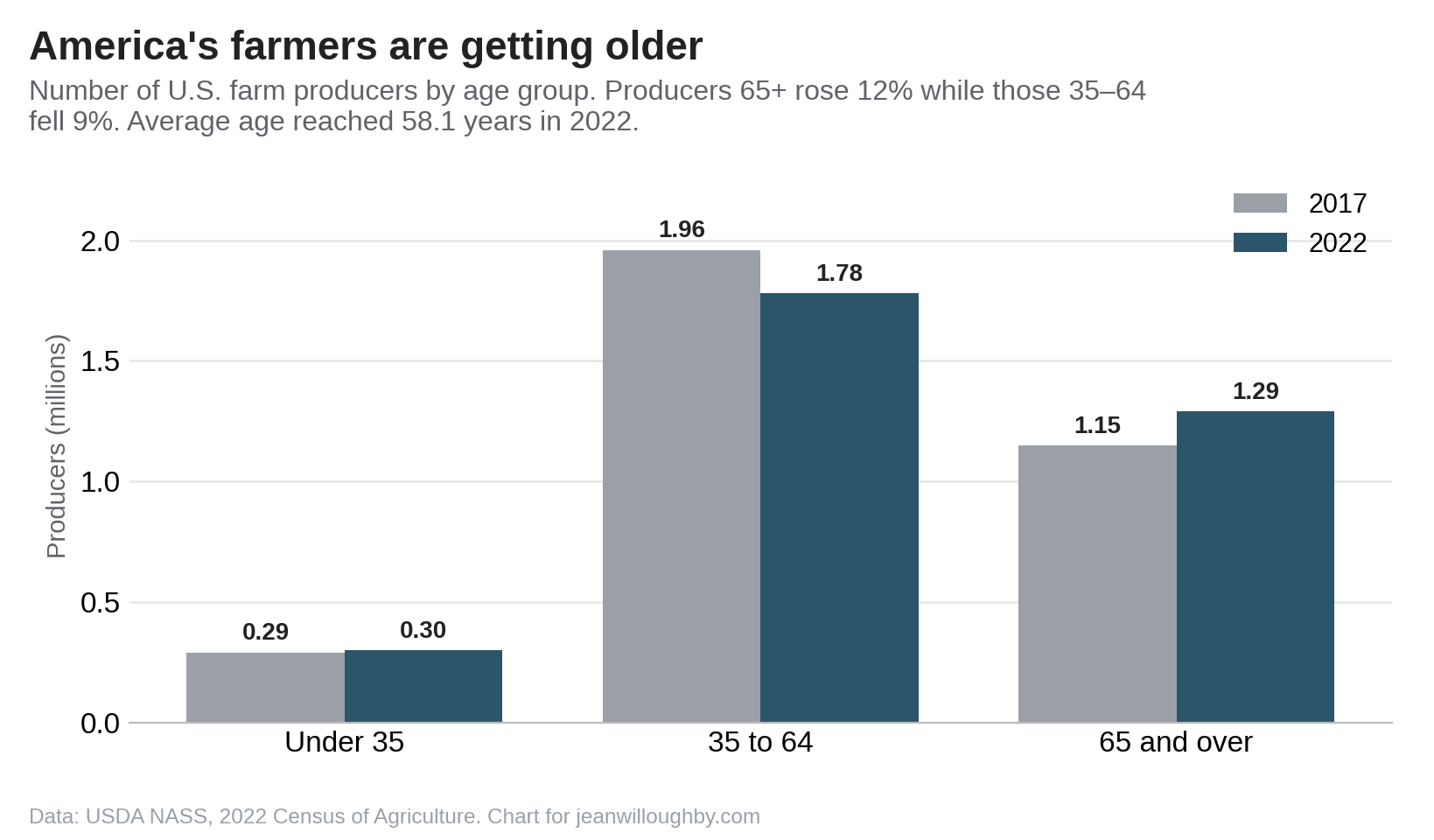
Today, the average U.S. farm producer is around 58.1 years old. Between 2017 and 2022, the number of producers aged 65 and over grew by 12 percent, while the number aged 35 to 64, the core of the working farm population, fell by 9 percent. There is some good news buried in the data: over a million producers are beginning farmers with ten or fewer years of experience, and the youngest cohort grew slightly. But the overall trajectory is clear.
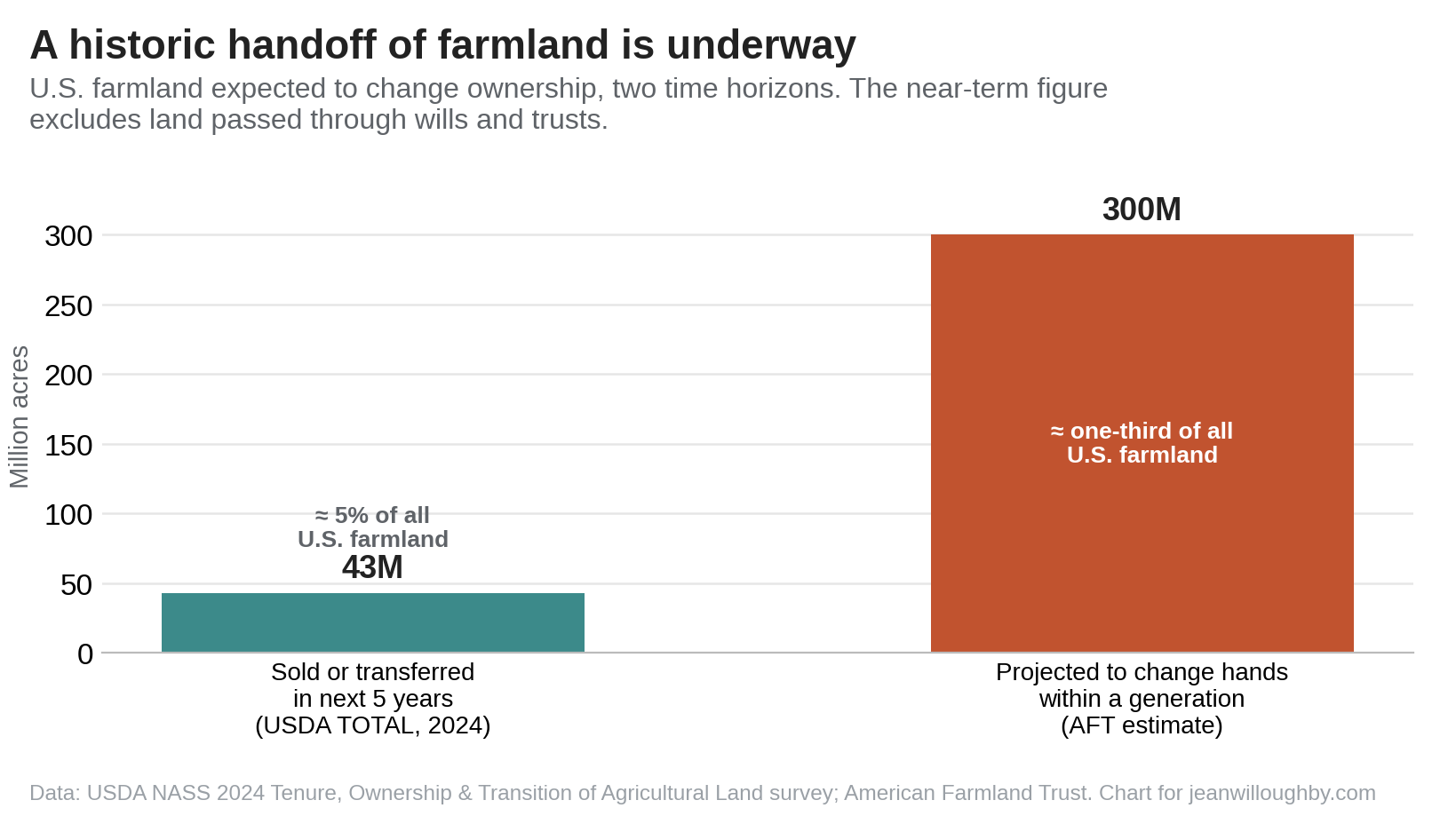
Because farmers are aging, an enormous amount of land is about to change hands. The USDA’s newest Tenure, Ownership, and Transition of Agricultural Land survey, released in 2026, found that about 43 million acres — roughly 5 percent of all U.S. farmland — are expected to be sold or transferred within five years, and that figure doesn’t even include land passed down through wills and trusts. Look out over a generation and the numbers get much bigger: American Farmland Trust has estimated that on the order of 300 million acres — roughly a third of all U.S. farmland — will change hands in the coming decades.
Who’s holding the land in the meantime? Increasingly, people who don’t farm it. The same survey found that most rented farmland is owned by non-operating landlords whose average age is around 69, more than a decade older than the average farmer. For a young person who wants to farm, this is the wall they hit: land is expensive and leases are typically short and insecure. The people who own the ground are aging too, often bringing further challenges as families navigate what comes next for eldercare as well as the family legacy on the land. The handoff is coming, but don’t expect an orderly passing of the baton.
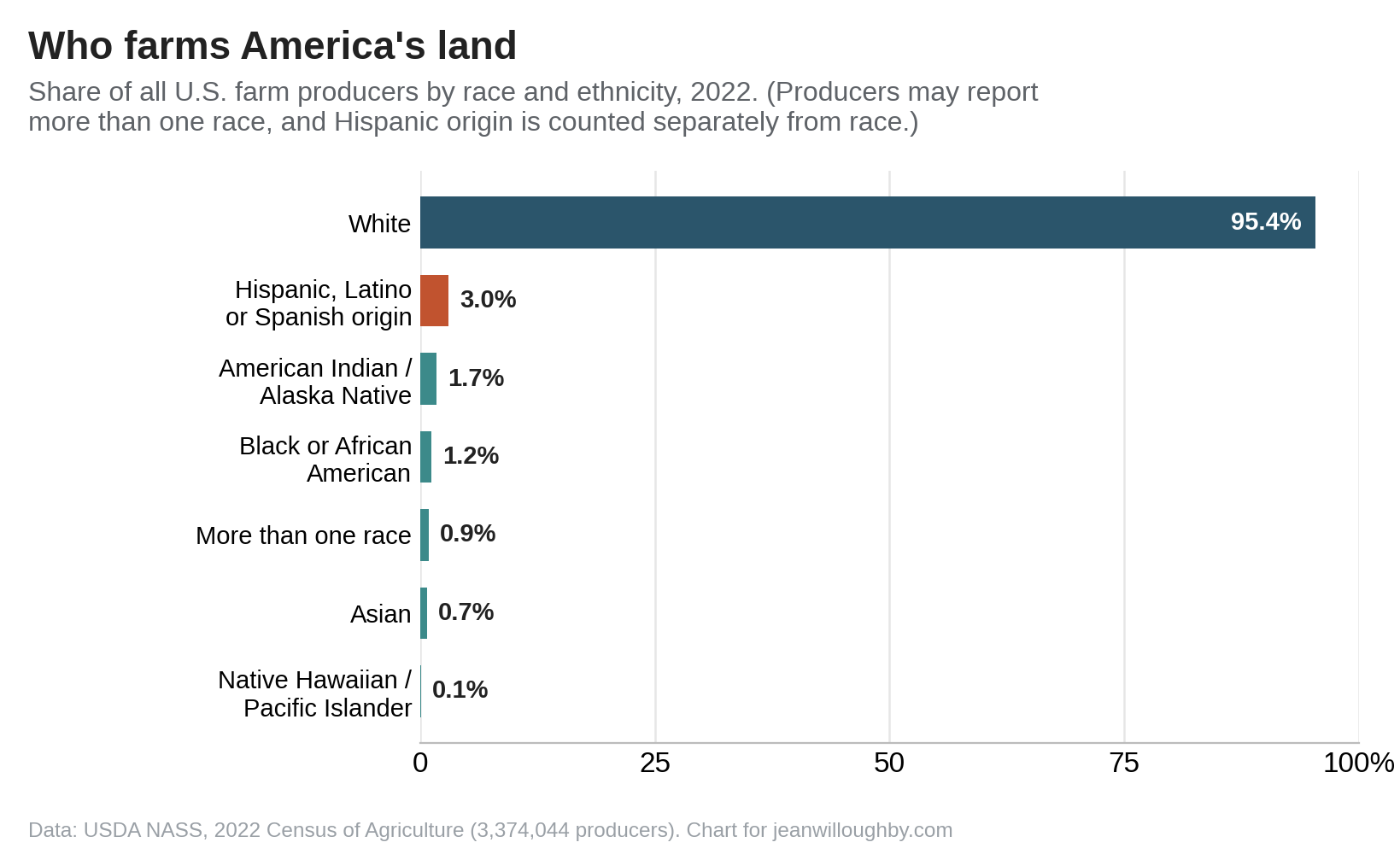
If the land is changing hands, the obvious question is: into whose hands? Today’s picture is striking. In 2022, about 95 percent of U.S. farm producers identified as White. Hispanic producers made up about 3 percent; American Indian or Alaska Native producers, 1.7 percent; Black producers, 1.2 percent; Asian producers, under 1 percent.
And producer counts actually understate the concentration, because land and acreage are even more unevenly held than the number of people. As of the 2017 Census, White producers owned on the order of 500 million acres of farmland; Black producers owned under 3 million. This didn’t happen by accident. Over the last century, Black families lost an estimated 16 million acres of farmland, much of it through discrimination by the very federal agencies that were supposed to serve them, along with predatory lending, partition sales, and outright violence.
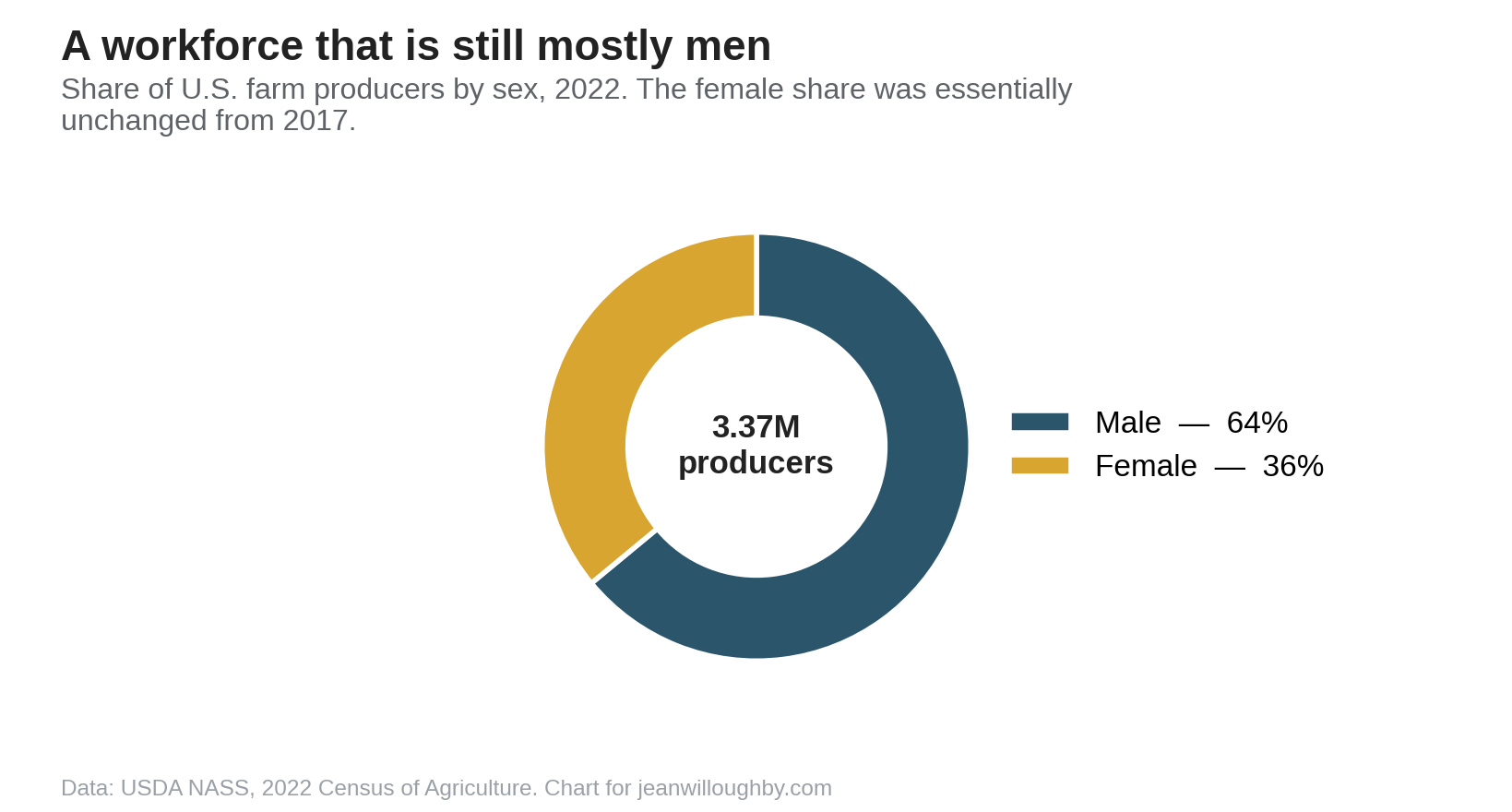
The gender picture is lopsided too, though shifting slowly. About 64 percent of producers are men and 36 percent are women. This ratio barely moved between 2017 and 2022, even as women took on more of the day-to-day and financial management of farms.
Why this is the moment that matters
A generation of farmers is retiring. Hundreds of millions of acres will change hands. Ownership is already concentrated by race, gender, and wealth. So this transition is a fork in the road: the same handoff that could entrench concentration even further is also a once-in-a-generation chance to broaden who gets to own and steward land.
That’s exactly why the recent federal cuts sting. In March 2026, the USDA terminated 49 of the 50 projects funded under its Increasing Land, Capital, and Market Access program, nearly $300 million across 40 states, and one of the only federal efforts focused squarely on land access for the next generation of farmers. A year earlier, the EPA canceled roughly $1.5 billion in Community Change Grants for environmental-justice projects; the agency’s own inspector general later found no problems with how those grants had been awarded. Communities and their lawyers are still fighting many of these terminations in court.
I don’t share these numbers to leave you in despair. I share them because the data is the case for hope with a plan. Land ownership is shifting. The only real question is whether we decide, deliberately, to widen the circle of who can farm it.
Sources
All four charts above are free to reuse for educational purposes with attribution; sources are listed below.
- 2022 Census of Agriculture, USDA NASS — producer demographics, age, race, ethnicity, and sex.
- 2024 Tenure, Ownership, and Transition of Agricultural Land (TOTAL) survey, USDA NASS — near-term land-transfer projections.
- American Farmland Trust, on farmland expected to change hands within a generation.
- 2017 Census of Agriculture (Table 61), for acreage owned by race; reporting on 20th-century Black land loss.
- Reporting from POLITICO, Civil Eats, Agweek, and others on the 2026 termination of the USDA Increasing Land, Capital, and Market Access program and the 2025 EPA Community Change Grant terminations.
Graphic design and visuals by Jean Willoughby; free to reuse for educational purposes with attribution.